 INR (₹)


Some exhibitions begin in boardrooms. Others take shape over emails, proposals, and contracts. But every once in a while, an exhibition begins somewhere far more human on unfamiliar streets, over shared meals, inside studios that feel like homes, and through conversations that quietly reshape intent.
The solo exhibition of Raja Segar in Delhi began exactly this way, with a journey to Sri Lanka undertaken by Shashank Maurya and Aakshat Sinha. What was planned as a professional visit to select works and formalise a show gradually transformed into an experience that deepened trust, friendship, and artistic conviction.
This is the story behind that journey.
First Impressions: Colombo Opens Itself
Sri Lanka announced itself gently.
As Shashank and Aakshat stepped out of Bandaranaike International Airport, Colombo unfolded as an emerald city, lush, warm, slightly humid, and immediately more breathable than Delhi. The air felt slower, calmer. And waiting outside was the artist himself.
Raja Segar arrived not with ceremony, but charm, driving an old classic Mercedes, smiling broadly, looking every bit like a quirky scientist who had stepped out of his own laboratory of ideas. It was an unspoken signal: this collaboration would be personal.
As they drove through Colombo, the city revealed itself in layers: colonial remnants, tropical greenery, quiet confidence. The gallery conversations had already begun, without words.
The House That Is Also a Studio
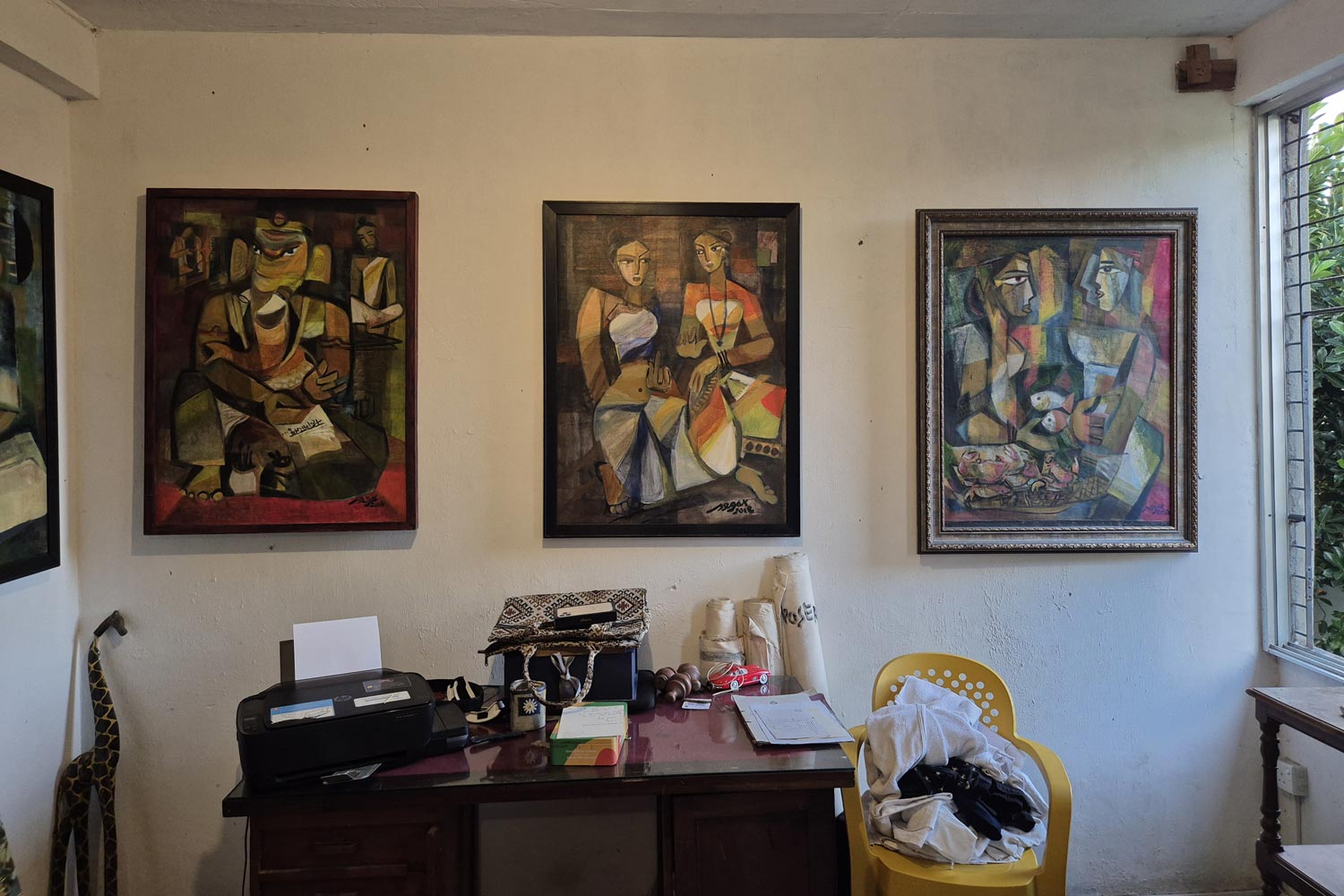
Raja drove them to a house built by an architect friend, designed carefully to serve as both home and studio. This was not a separate, sterile workspace. The house breathed art.
It doubled as Raja’s studio and gallery, and also as the working and living space of his son, Donovan, who is building customised sports cars under the Segar brand, a tribute to his father. Creativity here was not compartmentalised; it flowed across generations and disciplines.
The atmosphere was familial, unforced. Two mastiffs, also a father-son duo, moved around the space as Raja’s works quietly surrounded everyone. Canvases leaned against walls, others hung with assurance. This was where theory dissolved into presence.
For Shashank, this moment was crucial. As a gallerist, he had seen countless artworks digitally, in studios, in fairs, but standing here, in the artist’s world, he could sense the seriousness and lived integrity behind the practice. This was not just an artist to be shown. This was an artist to be understood before being introduced to India.
Seeing the Work, Really Seeing It
Until then, Raja Segar’s works had been experienced mostly through screens, Zoom studio visits, shared images, and discussions across time zones. But encountering them physically was something else entirely.
Textures emerged. Scale mattered. Emotional density became tangible.
As they spent hours looking through Raja’s ready collection, conversations naturally shifted toward the upcoming solo show at Bikaner House, New Delhi. The intention was clear: this trip had one purpose to thoughtfully select works that would represent Raja Segar to an Indian audience with honesty and strength.
Photos were taken. Videos and audio recordings followed. Conversations flowed easily, punctuated by laughter and a couple of beer cans. It didn’t feel transactional. It felt collaborative.
Later that evening, Raja drove them into the heart of the city, where he usually lives.
Family, Food, and the Rhythm of Trust
In the main city apartment, Raja’s daughter Spindonna lived in the neighbouring building. She joined them that evening not just as family, but as a gracious host who had prepared a traditional Sri Lankan dinner.
The meal grounded the day. Tired but exhilarated, the group shared stories about art, life, journeys, failures, and persistence. For Shashank, moments like these confirmed something important: great exhibitions are built not just on aesthetics, but on trust and hospitality.
The night ended early. The next day promised more.
Mornings in the Studio
By the time Shashank and Aakshat woke around 9 a.m., something remarkable had already happened.
Raja had been at the easel.
Early mornings are his time. He paints fast, instinctively, without ceremony. A partially completed new work stood quietly fresh, alive, unfinished. It was a reminder of why physical proximity to an artist matters. You don’t just see finished works; you witness the process.
After breakfast, Raja personally walked them through the works that adorned his apartment walls. Each piece carried contextual, emotional, and historical, intuitive. For Aakshat, this walkthrough deepened curatorial clarity. For Shashank, it reaffirmed confidence: this was an artist India needed to see more of.
Colombo Beyond the Studio
The days that followed blurred into discovery.
Raja took them across Colombo—through notable city landmarks, galleries, and eventually to his own shop in a nearby mall. The shop was active, alive with locals and tourists. Raja Segar was not just respected here; he was recognised.
For a gallerist, this mattered. It demonstrated that Raja’s work lived in both institutional and public spaces, bridging seriousness and accessibility.
They visited a university where they encountered the annual student exhibition alongside an open-call artists’ show. The visit reinforced how deeply art education and practice were woven into Colombo’s cultural life.
At the Russian Cultural Center Colombo, they were warmly received by Maria Popova, adding another layer of international cultural exchange to the trip.
The visit to Barefoot Gallery and the Sapumal Foundation museum provided historical grounding, offering insights into Sri Lankan art history and its contemporary trajectories.
On their final night, dinner with local artists like Godwin Constantine turned into laughter and karaoke, an unplanned but perfect ending to a deeply human journey.
Decisions That Shaped the Show
By the end of the visit, some works were selected from Raja’s collection. But something more significant emerged through conversations and shared time.
It was decided that Raja Segar would travel to Delhi a month before the exhibition and create new works specifically for the show.
For Shashank, this decision was instinctive. As a gallerist, he knew that hosting Raja in India, bringing him into his own home, his own rhythm, would allow the exhibition to be shaped with intimacy and intention. It was no longer about logistics alone. It was about belonging.
The decision to bring Raja not just to India, but home, would later define the soul of the exhibition.
Beyond Business, Toward Belief
What began as a professional visit turned into something far more meaningful.
There was pleasure in the journey, yes, but also clarity. Raja Segar, the artist, became inseparable from Raja Segar, the human being. His generosity, discipline, humour, and humility revealed themselves naturally.
For both Shashank and Aakshat, the visit redefined what it means to represent an artist. It reinforced the idea that exhibitions are not products; they are relationships made visible.
And when Raja Segar finally arrived in Delhi, and the works created during that shared time were unveiled, they carried within them the spirit of Colombo, of conversations, of early mornings, of shared meals, and of trust built quietly, far from gallery walls.
That is the unseen foundation on which the exhibition stood.
And that is why it mattered.